Authentication Experience Redesign
Reducing login friction across email, WhatsApp and authenticator-based verification.
Role
Senior Product Designer
Industry
Private Banking
Duration
3 months
My role
Led end-to-end UX for the authentication redesign.
Facilitated discovery and solution workshops.
Partnered with Product, Engineering, and Security teams.
Defined interaction patterns, prototypes, and validation.
Supported implementation and post-launch measurement.
The problem
Authentication is one of the most critical moments in the customer journey, especially in private banking, where trust and reliability are essential.
Through support tickets, internal feedback, and FullStory session recordings, we identified a recurring source of friction in the OTP verification flow. Customers were required to manually trigger code delivery by clicking a separate "Get Code" button — a step that was frequently overlooked.
The experience was further impacted by relying exclusively on email delivery. OTPs could take several minutes to arrive or, in some cases, fail to arrive altogether, preventing customers from successfully completing the login journey and increasing support requests.
Together, these issues created unnecessary friction in one of the product's most critical journeys and became a clear priority for redesign.
Discovery
To validate our assumptions, we combined multiple sources of evidence, including support ticket analysis, internal team feedback, user research sessions, and FullStory session recordings. Together, these helped us identify recurring patterns, understand customer behavior, and align product, engineering, and security teams around the problem.
We also benchmarked authentication experiences across private banking and broader financial services to understand industry patterns and explore alternative approaches.
These activities led to two key insights that shaped the final solution.

Exploration & Trade-offs
Beyond launch
During implementation, I partnered closely with Engineering to validate edge cases, support QA, and ensure the shipped experience matched the design intent.
After launch, we continued monitoring customer behavior, support tickets, and customer feedback to identify additional optimization opportunities.

Final experience

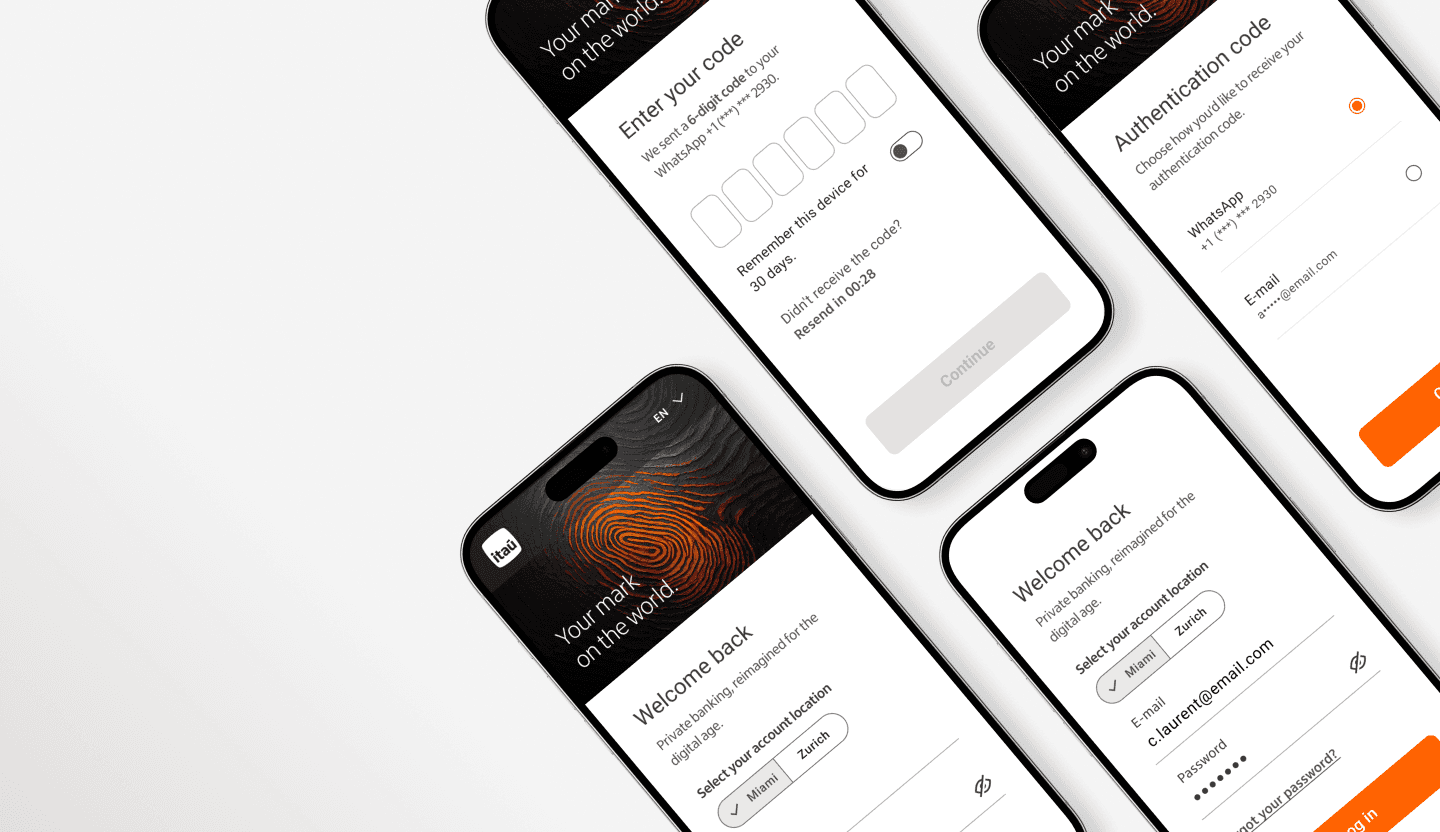
The redesigned flow simplified authentication while improving reliability by allowing customers to select how they wanted to receive their verification code before the OTP was generated.
The experience consists of four simple steps:
Sign in
Choose authentication method
Verify identity
Access account
Results
The redesigned authentication flow significantly reduced login friction while introducing a more flexible and resilient verification experience.
Following the rollout, the team monitored user behavior, support tickets, and customer feedback to validate the redesign. The new flow reduced confusion around OTP generation, simplified the verification process, and eliminated dependency on a single authentication channel.
Impact
93% successful login rate
49 seconds average login completion time
Customer Effort Score increased from 33% to 83% within three months
